See which of the factors in this article are holding your face back.
Start my face analysisDoes Mewing Work? What the Evidence Says About Tongue Posture and Your Jawline
Mewing promises a new jawline from a resting tongue, and the evidence for that is close to nothing, but the idea sits right next to one that genuinely works.
- Updated October 6, 2026
- 9 min read
- GodModeLooks editorial team
The evidence
- The claim
- That mewing reshapes an adult jaw, cheekbones or face. No randomized trial, cohort or imaging study shows it, and the American Association of Orthodontists warns against it.
- Weak or contested
- Thin, conflicting or refuted evidence, or none at all. When a popular claim lands here, we tell you, and we tell you what to do instead. How we grade evidence
We do not recommend mewing to change your face, and we will never show you a mewing before and after. If you want to train your tongue, train it for the thing trials support: snoring, sleep apnea severity and daytime sleepiness.
Key takeaways
- 01No controlled study of any kind shows that mewing changes an adult's jaw, cheekbones or face shape, and the American Association of Orthodontists warns that forceful mewing can tip teeth and change your bite.
- 02Mewing before and after photos prove nothing, because age, weight loss, head posture, camera angle and lighting all change how a face photographs, and photo-to-photo variation alone is large.
- 03Training the tongue and throat muscles does have trial evidence: in randomized trials, daily exercises reduced sleep apnea severity and daytime sleepiness.
In this article
Mewing might be the most famous idea in looksmaxxing. Press your whole tongue to the roof of your mouth, keep your lips sealed, hold it all day, and over months your jaw sharpens, your cheekbones lift and your face moves forward. The internet is full of before and after photos that seem to say it works.
The research says something very different. And if you are going to spend months of effort on your face, you deserve the version that is true, including the part of the tongue story that genuinely holds up.
The short answer
There is no controlled study of any kind showing that mewing changes an adult's jaw, cheekbones or face shape. Not a randomized trial, not a cohort, not a standardized imaging study.[1] Weak or contested
That is not the same as a study finding that mewing fails. It is an absence: the claim has simply never been tested in a way that could show it works. For an idea this popular, that absence is the most important fact about it.
What this means for you: any confident promise that mewing will give you a jawline is a promise nobody has the evidence to make.
What orthodontists actually say
The American Association of Orthodontists, the professional body for the specialists who move teeth and jaws for a living, issued a warning in January 2024. Its position is that there is no scientific evidence mewing reshapes the jawline.[1, 2]
It also lists real risks from forceful mewing:
- Loosened or tipped teeth.
- Bite changes.
- Tooth wear.
- Effects on speech.
What this means for you: the specialists closest to the question are not neutral on it. They warn against it.
Why before and after photos prove nothing
If mewing does not work, why do the transformation photos look so convincing? Because photos of the same face vary far more than most people realize.
Two independent labs have shown that different photos of the same person can vary more in rated attractiveness than photos of different people do.[3, 4] Moderate evidence Lighting, camera angle, expression and grooming all shift the impression a face makes, and those impressions form within a fraction of a second.
Now add what changes over the months a mewing journey takes:
- Age. Teenagers and young adults are still changing, with or without mewing.
- Weight. Losing body fat changes the jaw and cheek area visibly. If that is what you actually want, read what the research says about face fat.
- Head posture. How you hold your head and neck changes the picture too, which is covered in our posture article.
- Camera angle and lens distance. Angle is one of the variables that changes how the same face is rated.
- Lighting. The same face under different light can make a different impression.

Any of these alone can produce a dramatic before and after. Together, they explain the internet's mewing gallery without any change to bone at all.
What this means for you: never judge a facial change from two casual photos. If you want to track your face, use the same light, the same angle and the same distance every time.
How to test any facial claim yourself
The same photo problem that makes mewing look miraculous will make anything look miraculous, from jaw trainers to face yoga. So before you believe a transformation, yours or anyone else's, hold it to a simple standard.
- Same camera, same distance. Mark the spot and use it every time.
- Same height and head angle. Camera at eye level, head level, chin neither tucked nor pushed forward.
- Same light. Face a window or use one fixed lamp in front of you.
- Neutral expression, relaxed jaw. Expression is one of the things that shifts how a face is rated from photo to photo.
- Note your weight. If your weight has moved, your face has too, regardless of what else you did.
If a change survives all of that, it is worth taking seriously. Almost none of the mewing gallery would.
What this means for you: the standard costs nothing, and it protects you from spending months on a technique because of a lighting change.
Orthotropics and the people behind it
Mewing is closely tied to orthotropics, an approach founded by John Mew and promoted by his son Mike Mew.
Orthotropics has no controlled-trial evidence base. Weak or contested It is also worth knowing the regulatory record. John Mew was struck off the UK dental register by the General Dental Council in 2017. Mike Mew was erased from the register in November 2024, after hearings concerning his treatment of two patients with expansion appliances and headgear.[5, 6]
That record does not prove every idea associated with the name is wrong. It does mean the approach is not a proven alternative to orthodontics, and that the two people most associated with it have both been removed from the dental register by their regulator.
What this means for you: if someone sells you orthotropics as a proven replacement for braces, they are claiming something no trial supports.
What about children?
There is a real clinical field nearby: orofacial myofunctional therapy, exercises for the lips, tongue and face, sometimes used alongside orthodontics in children.
The evidence that it corrects a bite on its own is limited. A systematic review of studies published between 1965 and 2011 found 355 papers, of which only 4 met the criteria for inclusion, and all 4 were at high risk of bias. Later reviews have not established a causal link either.[7] Weak or contested
This is also the place where facial growth can genuinely be influenced. As our article on mouth breathing explains, the research linking breathing and face shape is research on growing children, and the adult skeleton is a different matter.
What this means for you: questions about a child's bite or facial growth belong with a dentist or orthodontist, not with a mewing tutorial.
The part of the tongue story that does work
Here is the pivot, and it is the reason this article exists. Mewing is about bone, and the bone claim has no evidence. But right next to it sits a claim about muscle, and that one has trials.
Snoring and obstructive sleep apnea are problems of the upper airway during sleep, and trials show that the muscles of the tongue and throat around it can be trained, with measurable effects on both.
The meta-analysis
A 2015 meta-analysis pooled 11 studies of mouth and throat exercises: 9 in adults, with 120 people, and 2 in children, with 25.[8]
- In adults, the apnea-hypopnea index, a measure of how often breathing stops or becomes shallow during sleep, fell from 24.5 to 12.3 events an hour. That is roughly half.
- In children it fell by about 62%.
- Objectively measured snoring fell by 72%.
- Daytime sleepiness scores dropped from 14.8 to 8.2.
- Protocols ran for 5 to 30 minutes a day, for 2 to 6 months.
Most of those studies had no control group, so the size of the effect is uncertain. The direction is clear. Moderate evidence
The Cochrane review
A Cochrane review looked only at randomized trials: 9 of them, with 347 participants, comparing real exercises with sham therapy.[9]
- Daytime sleepiness fell by 4.52 points, at moderate certainty.
- Subjective snoring intensity fell by 1.9 points, at moderate certainty.
- Sleep apnea severity fell by 13.2 events an hour, at low certainty.
- Snoring frequency showed little or no effect.
A 2025 meta-analysis of 5 randomized trials found a similar picture, with sleep apnea severity down 8.85 events an hour and sleepiness scores down 4.49.[10]
Daily mouth and throat exercises have been shown in randomized trials to reduce sleep apnea severity and daytime sleepiness. Emerging evidence The sleepiness result is the firmer of the two, at moderate certainty.

The didgeridoo trial
One of the more memorable proofs that the upper airway is trainable was published in the BMJ. Twenty-five adults with moderate sleep apnea who snored were randomized to four months of didgeridoo lessons and daily practice, or to a waiting list.[11]
The players practiced for about 25 minutes a day, six days a week. Their daytime sleepiness fell by 3.0 points, partner-rated sleep disturbance fell by 2.8 points, and their sleep apnea severity fell by 6.2 events an hour. It was a small trial, so treat it as an illustration rather than a prescription. Emerging evidence
What the trial protocols looked like
The programs in these studies were not "hold your tongue up all day". They were structured sets of exercises for the tongue, soft palate and throat, done for a set time each day: 5 to 30 minutes, for 2 to 6 months in the meta-analysis, and about 25 minutes a day, six days a week, in the didgeridoo trial.[8, 11] In the Cochrane review, the comparison was sham therapy, which is what lets the sleepiness result be taken seriously: people doing pretend exercises did not improve as much.[9]
That structure is the real difference between this and mewing. Mewing is a posture held as hard and as long as possible, aimed at bone. Myofunctional therapy is training, done in sessions, aimed at muscle tone and the airway, and measured in sleep studies rather than selfies.
What this means for you: if you snore, or you are often sleepy during the day, structured tongue and throat training is one of the few "tongue" ideas with real trials behind it. Talk to a doctor first, because snoring and sleepiness can be signs of sleep apnea, and only a sleep test can diagnose it.
What resting tongue posture honestly is
So where does that leave the resting posture itself, tongue up and lips together?
Resting your tongue on the palate with your lips closed supports nasal breathing. There is no evidence that it remodels adult bone.[1]
That is a perfectly reasonable habit. Nasal breathing is a sensible default, for reasons covered in our airway article. Just keep the expectation honest: a comfortable, relaxed resting posture, not hours of hard pressure, and not a promise of a new jawline.
What this means for you: rest your tongue gently if it feels natural. Do not push. Do not expect your face to change because of it.
What to do instead
If you came to mewing because you want a sharper, more defined lower face, here is where the evidence actually points:
- Body fat. Facial leanness tracks total body fat, and the research on how much fat loss shows in a face is some of the most concrete in this field. Read body fat and facial definition.
- Presentation. Light, angle, grooming and posture change how a face is rated more than most people expect. Start with posture.
- Sleep. If you snore or wake tired, train your airway for the reason trials support, and see a doctor. More in sleep and appearance.
- A specialist. If your bite or jaw width is a real problem, an orthodontist can tell you whether bone-anchored expansion or other treatment fits. That is covered in the airway article.
Mewing promised you a shortcut that nobody has shown exists. The honest version is less magical and more useful: train the muscles for sleep, and work on the things that do change how your face looks.
Turn the research into a plan
Reading is the easy part. The quiz and scan show which of these factors matter for your face, and in what order to work on them.
01
Answer the questions
Your goals, your routine, your skin, hair, body and style, and how you feel walking into a room. Tap answers only — nothing to type.
02
Take two photos
One front, one side, in even light. You see exactly what you are agreeing to before the camera opens, and you can skip the scan entirely.
03
Get your report and plan
Your scores, what is working for you, what is holding you back, and a plan ordered by the priorities you chose.
Frequently asked questions
Does mewing actually work?
For changing an adult face, there is no controlled evidence that it does. No randomized trial, cohort or imaging study has shown mewing reshaping adult bone, and the American Association of Orthodontists warns against it.
Is hard mewing faster?
There is no evidence that it works at all, and forceful mewing is what the AAO warns can loosen or tip teeth, change your bite, wear teeth and affect speech. We do not recommend it.
Is there anything good about tongue posture?
Resting your tongue on the roof of your mouth with your lips closed supports nasal breathing. Separately, structured mouth and throat exercises have been shown in randomized trials to reduce sleep apnea severity and daytime sleepiness. Neither has been shown to remodel adult bone.
Can tongue exercises replace CPAP?
No. The trials show they can reduce severity and sleepiness as an add-on, not that they cure sleep apnea or replace treatment. If you think you have sleep apnea, talk to a doctor about a sleep test.
References
- 01Risks of Mewing. American Association of Orthodontists. ↩
- 02[coverage of the AAO’s warning against mewing]. Dental Products Report. ↩
- 03Jenkins R et al. (2011) Cognition 121(3):313–23. doi.org ↩
- 04Todorov A, Porter JM (2014) Psychol Sci 25(7):1404–17. doi.org ↩
- 05(2024) [report of the General Dental Council’s 2024 decision on Mike Mew]. Scottish Dental Magazine. ↩
- 06[report of the General Dental Council’s decisions on John and Mike Mew]. DentistryIQ. ↩
- 07Homem MA, Vieira-Andrade RG, Falci SG et al. (2014) Dental Press J Orthod. pmc.ncbi.nlm.nih.gov ↩
- 08Camacho M et al. (2015) Sleep 38(5):669–75. doi.org ↩
- 09Rueda JR et al. (2020) Cochrane Database Syst Rev, CD013449. doi.org ↩
- 10Ferreira LGDA et al. (2025) Int Arch Otorhinolaryngol. doi.org ↩
- 11Puhan MA et al. (2006) BMJ 332:266–70. doi.org ↩
Keep reading
Face structure
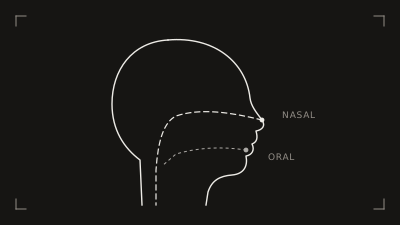
Does Mouth Breathing Change Your Face?
The link between breathing and face shape is one of the most repeated ideas in looksmaxxing, and the honest version is narrower, and more useful, than the one you have heard.
Body & habits
Is Beauty Sleep Real?
Sleep changes how your face reads to strangers, though less dramatically than the internet claims, and its biggest effect on your looks may run through your appetite.
Face structure
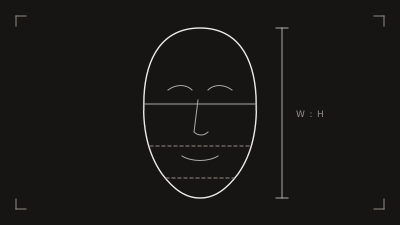
Body Fat and Your Face
Your jawline may already be there. The research says how much fat loss it takes before other people notice, and it is less than you might think.
This article is educational and about appearance. It summarizes published research and is not medical advice, a diagnosis or a treatment, and what a study found in its participants is not a promise about what GodModeLooks will do for you.